- SELF STUDY MODULES
- 1. Intro to TBI
- 2. Communication
- 3. Skills for independence
- 4. Cognitive changes
- 5. Behaviour changes
- 6. Sexuality
- 7. Case management (BIR)
- 8. No longer available
- 9. Mobility & motor control
- 10. Mental health & TBI:
an introduction - 11. Mental health problems
and TBI: diagnosis
& management - 12. Working with Families
after Traumatic Injury:
An Introduction - 13. Goal setting
5.1 Behaviour changes following TBI
If you have completed Module 4
Go direct to 5.3 Analysing problem behaviourwith a view to management as you will have already covered 5.1 Changes following TBI in Module 4.3 and 5.2 Strategies for dealing with cognitive changes in Module 4.4
i) Consequences of traumatic brain injury
The consequences of a traumatic brain injury are diverse. After acute recovery and intensive rehabilitation, the individual, their family and friends need to adjust to the changed situation and face the long-term future.
When someone suffers traumatic brain injury, a number of problems may arise as a result of physical damage to the brain. The problems will vary from individual to individual, and will depend on a number of factors. These include:
- the person’s pre-injury cognitive strengths and weaknesses
- the person’s pre-injury personality and coping style
- the extent, location and nature of damage to the brain
- the extent of spontaneous recovery which takes place
TBI’s from motor vehicle accidents often cause a generalised pattern of cognitive impairments. This type of injury often involves twisting, & stretching of nerve cells and bleeding and bruising of the brain, as opposed to a localised or penetrating type of injury like a stab wound where the resulting impairments are usually more specific to the location of damage.
However each individual is likely to display a different pattern of impairments and few people exhibit all possible consequences. One type of deficit may be severe, another mild, and another absent. A person may, for example, have a poor memory, minor problem-solving difficulties but no change in their personality.
Apart from the brain injury itself, there are other factors that will affect the person’s behaviour. The circumstances they find themselves in is quite different –from their pre-injury lives. Some of the changes include:
- spending large amounts of time in hospital and attending appointments
- loss of social contacts and - friends
- loss of income and the financial uncertainty of the future
- physical impairments
- loss of independence and the need to rely on others for previously simple, day-to-day
activities.
ii) Cognitive changes
Examples of effects of some common cognitive changes are:
1. Information processing
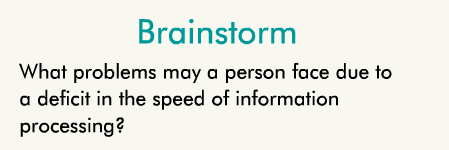
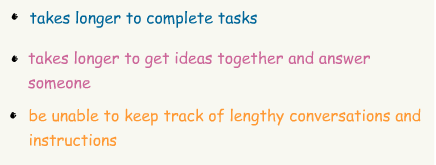
- slowed processing
- poor mental tracking
- fatigue
2. Attention
- short attention span
- poor concentration
- poor attention to detail
- easily distracted
3. Memory
- difficulty learning and/or remembering new information
4. Problem solving
- difficulty working out how to do things
5. Flexibility
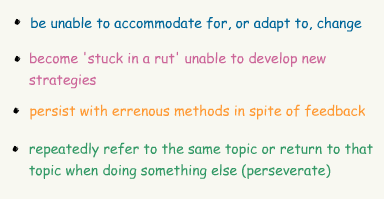
- unable to shift to or think of a new solution/method
- may perseverate (repeatedly refer to the same topic or keep returning to that topic)
6. Planning and organising
- poor preparation, eg. starting something without considering options
- difficulty understanding or recognising the steps involved
7. Reasoning
- thinking is often rigid and concrete
- tendency to take things literally
8. Self monitoring
- poor use of feedback and breaking rules
- not picking up on cues
9. Insight
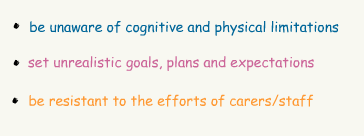
- unaware of own limitations
- unrealistic goals or expectations
The information provided here is a guide and doesn’t reflect hard and fast divisions. For example, a person having difficulty learning new information may have a poor memory and/or attention deficits or poor organisational skills.
Each individual is likely to show a different pattern of cognitive changes, often combined with some preserved abilities.
Problems that may arise due to cognitive deficits
A deficit in one of the cognitive functions listed above due to a TBI can lead to problems for the individual in terms of their behaviour.
iii) Brainstorm
Problems that may arise due to cognitive deficitsA deficit in one of the cognitive functions listed above due to a TBI can lead to certain problems for the individual in terms of their behaviour.
Check your answers here
 Check your answers here

Check your answers here