- SELF STUDY MODULES
- 1. Intro to TBI
- 2. Communication
- 3. Skills for independence
- 4. Cognitive changes
- 5. Behaviour changes
- 6. Sexuality
- 7. Case management (BIR)
- 8. No longer available
- 9. Mobility & motor control
- 10. Mental health & TBI:
an introduction - 11. Mental health problems
and TBI: diagnosis
& management - 12. Working with Families
after Traumatic Injury:
An Introduction - 13. Goal setting
1.2 Identify the epidemiology of TBI (eg sex, ratio, age distribution)
i) Population distribution
People in the 14 to 24 age group are more likely than people of other ages to get a TBI. Men are more likely than women to get a TBI. Road traffic accidents are the most common cause of TBI.
The following chart shows the incidence of TBI by age group for males and females separately (and a total for both groups). The incidence is show as the number of people per 100,000 of the population to get a TBI.
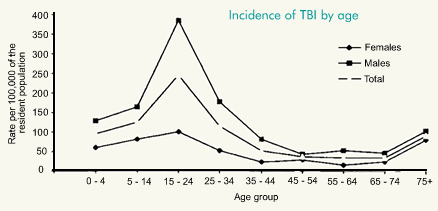
Looking at the above chart**, you can see that the peak incidence* of TBI is among young males. The male:female ratio for people with TBI is 3:1.The 15–25 years age group comprises 40% of survivors of TBI but only 15% of the Australian population.
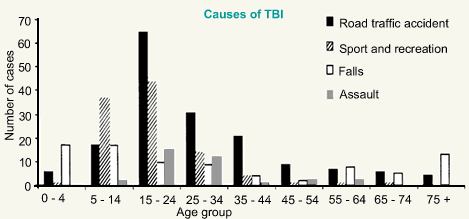
A second peak is observed after 75 years. But there are different causes for these two age groups. The main cause among young people is road crashes, whereas the main cause for the elderly is falls.
ii) Common causes of brain injury
Overall in relation to severe TBI, 64% are caused by road accidents (i.e. drivers, passengers, pedestrians, motor bikes, cyclists) and 36% relate to all other causes, including assaults, falls, sport/recreation, gunshot and other causes.
The following chart shows the causes of TBI by age group.
For further information about the incidence or prevalence of TBI, refer to the following articles in the references list (Fortune & Wen, 1999; Tate, McDonald, & Lulham, 1998).
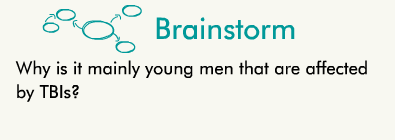
iii) Brainstorm
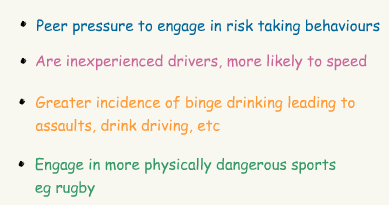
Check your answers here
Definitions & sources
Epidemiology
Epidemiology is the study of the incidence, distribution and control of a disease (or injury) in a population. It can be helpful to think of epidemiology in terms of who, where, when, what, and why. That is, who has the disease, where are they located geographically and in relation to each other, when is the disease occurring, what is the cause, and why did it occur.
Incidence
Incidence refers to the number of new cases in a year
Prevalence
Prevalence refers to the total number of cases present in the community
Sources
FORTUNE, N. & WEN, X. (1999), The definition, incidence and prevalence of acquired brain injury in Australia, Australian Institute of Health and Welfare, Canberra.
Tate, R., McDonald, S., & Lulham, J. M. (1998). Incidence of hospital-treated traumatic brain injury in an Australian community. Australian and New Zealand Journal of Public Health, 22(4), 419-423.