- SELF STUDY MODULES
- 1. Intro to TBI
- 2. Communication
- 3. Skills for independence
- 4. Cognitive changes
- 5. Behaviour changes
- 6. Sexuality
- 7. Case management (BIR)
- 8. No longer available
- 9. Mobility & motor control
- 10. Mental health & TBI:
an introduction - 11. Mental health problems
and TBI: diagnosis
& management - 12. Working with Families
after Traumatic Injury:
An Introduction - 13. Goal setting
1.4 Recognise how trauma impacts on the structures of the brain
i) Open & closed injuries
A TBI is usually classified as (i) closed or (ii) open
(i) Closed head injury
Acceleration/deceleration injuries - often occur during car crashes for example, a deceleration injury is when a moving person comes to an abrupt halt and the brain within the skull still has forward momentum and hits the inner surface of the skull causing injury.
Closed head injuries can also be caused by a blow to the head but the skull remains intact.
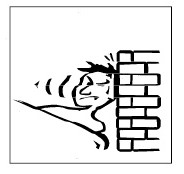
(ii) Open head injury
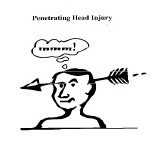
This can be caused by a blow to the head where the skull is fractured (broken) and the dura (brain coverings) are torn, exposing the brain. This classification also includes penetrating injuries.
Penetrating injuries - when an object penetrates the skull, causing injury to the brain.
For both of these types of mechanisms there are two types of injury that can result - primary injuries and secondary injuries. Primary injuries are injuries that are caused directly by the impact/penetration, at the time of the accident. Secondary injuries are complications that can arise from primary injuries after the accident and lead to further brain damage.
iii) Primary injuries
(1 min 10 sec)
During an acceleration/deceleration injury the brain can be damaged directly underneath where the skull has been hit (a contra lesion). The brain can also bounce around inside the skull from the force of the impact or acceleration/deceleration.
For example, if a car hits a tree, the car suddenly stops. The brain within the skull still has forward momentum and can hit the inner surface of the skull (which has bony edges) with some force, thereby causing bruising, lacerations and bleeding. In addition, the twisting motions that typically accompany such accidents mean that the bundles of nerve fibres can be stretched or shear (this is called diffuse axonal injury). The term closed head injury is also used to describe this type of TBI, because the damage to the brain occurs as the result of these internal mechanisms, but with the skull remaining intact.
A blow to the head can cause injury on opposite side of the brain to where the impact was as the brain bounces backwards (a contra-coup injury), commonly this damages the frontal and occipital lobes.
The nerve fibres (axons) that connect the different areas of the brain can also be subject to twisting and shearing forces during an acceleration/deceleration. This results in Diffuse Axonal Injury (DAI). This type of injury can't be seen on early CT scans, but often shows up later as areas of brain that are missing (atrophy). DAI is the most important mechanism of primary brain damage, and the prime cause of initial loss of consciousness
The brain exits the skull through a hole at the base of the skull and becomes the spinal cord. During a TBI incident the brain can begin to swell from injuries, which causes it to be pressed down into this hole in the skull. This can damage the brain stem and is extremely life threatening, because the brain stem controls the basic vital functions (e.g. breathing).
During a penetrating head injury the primary injury is to the area of brain damaged by the penetrating object. The remainder of the brain is usually not damaged unless it is from from secondary injury complications.
iii) Secondary Injuries:
Secondary complications that can lead to secondary injuries include:
- Breakdown of cell products leading to damage in adjoining cells
- Blood clots (haematomas) as the result of bleeding within the skull
- The brain can swell, either from a blood clot or swelling of the blood tissue (oedema). This increases the pressure of the brain on the inside of the skull which can reduce blood flow to the brain. Without enough blood flow, the brain is starved of oxygen which can lead to further damage (hypoxic brain damage)
- Local infection, typically associated with skull fractures, can lead to meningitis (inflammation of the meninges), inflammation of brain tissue (cerebritis) or abscesses
- Hydrocephalus, in which the gaps within the brain that contain cerebrospinal fluid (ventricles) become enlarged due to too much fluid
- Systemic failure such as reduced blood pressure, injury to the chest (pulmonary injury), or respiratory failure can all lead to further brain injury
Rapid retrieval and skilled early management can minimise secondary damage. This is especially important in preventing death and limiting disability. It is the reason for early retrieval work with ambulance and paramedical teams, minimising elapsed time from accident/injury to hospital.