- SELF STUDY MODULES
- 1. Intro to TBI
- 2. Communication
- 3. Skills for independence
- 4. Cognitive changes
- 5. Behaviour changes
- 6. Sexuality
- 7. Case management (BIR)
- 8. No longer available
- 9. Mobility & motor control
- 10. Mental health & TBI:
an introduction - 11. Mental health problems
and TBI: diagnosis
& management - 12. Working with Families
after Traumatic Injury:
An Introduction - 13. Goal setting
1.5 Recognise the process of recovery
i) Recovery
Recovery from a traumatic brain injury usually occus in several stages.
- Coma/altered consciousness
- Post traumatic amnesia
- Lucidity and recovery
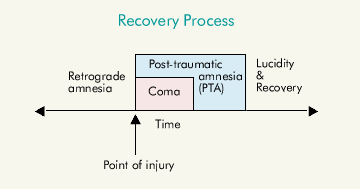
ii) Stages of recovery:
1. Coma/altered consciousness
Typically, at the point of injury, one of the immediate effects is that a person exhibits a depressed or altered state of consciousness. This may include a period of coma (a loss of consciousness). The length of unconsciousness can be measured on the Glasgow Coma Scale.
However, not everyone experiences a loss of consciousness (LOC) as the result of a TBI. Some people who are injured will be confused (i.e. in PTA) but without ever losing consciousness. One example of this is a football player, who is concussed as the result of a heavy tackle. The person may not lose consciousness, but may be confused and disoriented for a few minutes, not knowing that they are on a football field (this would be classified as a mild TBI).
2. Post-traumatic amnesia (PTA)
As people emerge from a coma, they go through a period of post-traumatic amnesia (PTA), during which the person is not orientated to time, place, person, and is unable to learn, and may display disinhibition, irritable or agitated behaviour. This is in contrast to the many misleading media portraits, in which a person emerges from a comatose state, as if waking from sleep, fully lucid and oriented.
The period of coma and/or PTA, can range from a matter of minutes, through to days, weeks or even months. The duration of PTA is measured until continuous memory is restored. Duration of PTA, as a measure of initial injury severity, is the best predictor of long term outcome after a TBI.
PTA less than one hour = a mild injury PTA of 1 - 24 hours = a moderate injury PTA of 1 - 7 days = a severe injury PTA 1 - 4 weeks = a very severe injury PTA more than 4 weeks = an extremely severe injury
3. Lucidity and recovery
As people emerge from coma and PTA and become more lucid, they also make rapid recovery of functioning more generally, including physical recovery, language, and functional abilities.
The most rapid recovery is in the first 6–9 months post-injury, but after two years most of the natural recovery has plateaued. After this time, the person can still make improvement, but this will be through a process of adjustment, making optimum use of intact abilities or developing strategies to compensate for remaining disabilities.
Retrograde amnesia
People who sustain a TBI will also characteristically lose some memories of the events preceding the injury. Once again, this memory loss may only last a few minutes, but in more severe cases, they may lose their memories for events that happened hours, days, weeks or even months before the injury. The loss of memory for events occurring prior to the injury is called retrograde amnesia.
Brainstorm

Check your answers here