- SELF STUDY MODULES
- 1. Intro to TBI
- 2. Communication
- 3. Skills for independence
- 4. Cognitive changes
- 5. Behaviour changes
- 6. Sexuality
- 7. Case management (BIR)
- 8. No longer available
- 9. Mobility & motor control
- 10. Mental health & TBI:
an introduction - 11. Mental health problems
and TBI: diagnosis
& management - 12. Working with Families
after Traumatic Injury:
An Introduction - 13. Goal setting
6.1b Sexuality issues for people with TBI and their family
People with a TBI often experience changes to their sexuality after the TBI.
There are primary causes (eg injury to the brain) and secondary causes (eg stress) that bring about these changes.
There is a wide range of change between individuals.
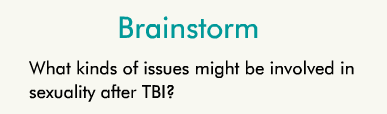
Check your answers here
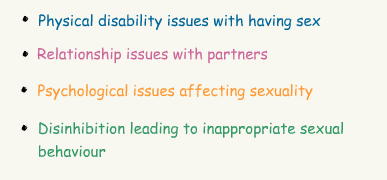
Common changes to sexuality after TBI
Lower sex drive
Lower sex drive Up to 41% of men report having a lower level of sex-drive after TBI. Only 15% report having an increased or greatly increased sex-drive (Ponsford, 2003). Up to 33% of women reported that they had a lower sex-drive after the injury.
Decreased frequency
Up to 54% of both men and women report that they had sex less often than before the injury. There are a number of reasons for this including relationship breakdown, difficulties starting new relationships, lower sex-drive.
Changes in arousal
Up to 30% of men report erectile difficulties after the injury (Kreuter et al., 1998) Erectile difficulties vary, with some people able to achieve only partial erections, or erections in some situations but not others, and others unable to achieve erections in any situation. It is not yet known whether environmental factors (eg. performance anxiety, depression) may be the cause of these difficulties as often as the brain injury itself. Up to 18% of women reported lower levels of vaginal lubrication after the injury (Hibbard et al., 2000)
Orgasmic problems
Up to 40% of both men and women reported decreased or no experience of orgasm post-injury (Kreuter et al., 1998)
Disruption to the menstrual cycle
It is common for a woman’s period to stop after a brain injury. It usually starts again after four to six months.
Causes of change
Primary causes
The whole of the Central Nervous System is involved in sexual activities, from low in the spinal cord up to the most evolved part of the human brain. The brain is a sexual organ. It has been said that the brain is the ultimate sexual organ: the seat of sexual urges, thoughts, sensations, inhibitions and behaviours.
A number of reflexes including the sexual responses of erection, ejaculation, and vaginal lubrication are located in the spinal cord or brain stem. In evolutionary terms these reactions are understood to be similar to the responses of our most primitive vertebrate ancestor.
The brain also developed elaborate and complex higher cortical functions located in the midbrain, limbic system and frontal area. And thus sexuality is emotional, social and relational, about the self, values, attitudes and beliefs as well as sexual functions. And these factors can impinge on that primitive reflex response.
Therefore, brain damage can impact directly upon sexual functioning. It can also have indirect affects, as it impacts upon many other factors (e.g. relationships, self-value, sense of self-attractiveness) which influence sexual feelings, functioning and performance.
Secondary causes
Stress can cause problems for people’s sexual functioning. Stress is a common reaction to TBI.
Depression and anxiety have also be found to be very common after TBI and can affect a person’s sexual life.
Medication used for various conditions after TBI may also affect sexual functioning.
Chronic pain is common after TBI and pain affects people’s enjoyment of sex and feelings of sexuality.
Relationship difficulties are common after TBI and impacts on the couple’s sex life.
Other physical injuries apart from the TBI can also affect the person’s sex life.
Range of changes
Domain |
Disability |
Impact on sexuality |
| Physical | Weakness or paralysis on one side Restricted movement in hands, arms or legs Tremor, Chronic pain Loss of sensation to touch Bowel dysfunction Bladder dysfunction Fatigue | Difficulty in transferring to and from bed Clumsiness in love making Some movements or positions can increase pain Parts of the body may not be aroused in response to touch Problems with applying contraceptives Fear of accidents, anxiety, embarrassment. Inhibits sexual desire and increases feeling of vulnerability and anxiety. Fatigue interferes with the sexual desire and the physical ability to initiate and sustain sexual activity. |
| Cognitive | Memory problems Reduced concentration | Person with brain injury forgets having sex Person with brain injury gets distracted during sex Forgets about contraception |
| Psychosocial | Sexual disinhibition, lack of initiation | Non-injured partner upset having to always initiate sex Complaints made about person’s sexual disinhibition |
| Psychological | Depression, increased anxiety, fatigue, loss of confidence, poor self image | Person with brain injury looses interest in sex or too tense to enjoy sex Non-injured partner frustrated or feels rejected Thinking that an appliance interferes with participation in sexual ability (eg catheter) |
| Sexual problems | Reduced sex drive, increased sex drive, problems with erections, ejaculation problems, vaginal dryness, orgasm problems | Cannot enjoy sex in the same way as before the injury Frequency of sex reduces or stop having sex Become concerned about capacity to have children Makes sex unpleasant Too embarrassed to ask for help |
| Social | Social isolation, relationship breakdown Partner may feel burdened with responsibility as carer Dependency, institutionalisation | Feel lonely, have trouble meeting people End up visiting a sex worker to have sex Lack of desire by lover related to difficulty separating carer role from that of partner Lack of privacy |