- SELF STUDY MODULES
- 1. Intro to TBI
- 2. Communication
- 3. Skills for independence
- 4. Cognitive changes
- 5. Behaviour changes
- 6. Sexuality
- 7. Case management (BIR)
- 8. No longer available
- 9. Mobility & motor control
- 10. Mental health & TBI:
an introduction - 11. Mental health problems
and TBI: diagnosis
& management - 12. Working with Families
after Traumatic Injury:
An Introduction - 13. Goal setting
6.5a Sexually inappropriate behaviour after TBI
Types of inappropriate sexual behaviour
Common types of inappropriate sexual behaviour encountered by staff after TBI include:
- exhibitionism
- genital touching
- non-genital touching
- coercive sexual assault
Touching genital areas refers to breast, buttocks or penis.
Touching non-genital areas refers to anywhere else on the body including patting a person on the knee, touching a person's shoulder, arm, back etc.
Coercive sexual assault refers to the forcible grabbing of a person, attempting to undress a person, attempting to have non-consenting intercourse with a person.
The following chart shows the relative incidents of these behaviours after TBI.
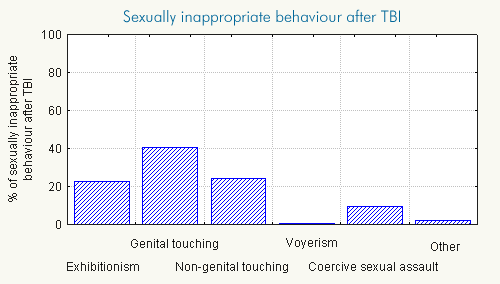
Simpson et al. 1999
Staff are a significant target group for inappropriate sexual behaviour encountered by people after TBI.
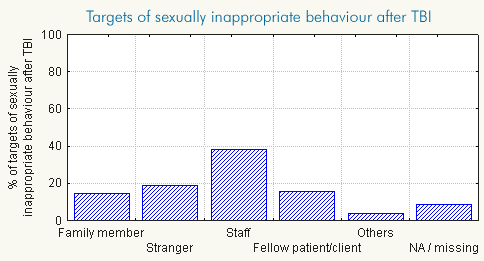
Simpson et al. 1999
Causes of sexually inappropriate behaviour
Most commonly, sexually inappropriate behaviour is the result of disinhibition not hypersexuality. We know this because low sex drive is far more common than increased sex drive after TBI. So a person can have low sex drive but still act in a sexually disinhibited way. This is because different mechanisms within the brain are involved. This is an important distinction.
Some forms of brain damage may lead to "loss of moral-ethical restraints and to gross sexual misconduct without any hypersexuality, i.e. without increased frequency of sexual arousal." Walker, 1976. The neurological basis of sex. Neuorology India, 24, p.7.
"Injury to the older baso-orbital region may produce disinhibited, sexually inappropriate behaviour, which may be verbal and devoid of any true sexual arousal." Horn & Zasler, 1990. Neuro-anatomy and the neurophysiology of sexual function. Journal of Head Trauma Rehabilitation, 5(2), p. 5.
"...make a distinction between disinhibited sexual behaviour and hypersexual behaviour. According to this view, true hypersexuality is more common with damage to the limbic system of the brain, whereas disinhibited sexual behaviour, as a part of general disinhibition, seems to be related to involvement of the frontal lobes and associated structures." Miller, 1994. Sex and the brain injured patient. Journal of Cognitive Rehabilitation, May/June, p.14.