- SELF STUDY MODULES
- 1. Intro to TBI
- 2. Communication
- 3. Skills for independence
- 4. Cognitive changes
- 5. Behaviour changes
- 6. Sexuality
- 7. Case management (BIR)
- 8. No longer available
- 9. Mobility & motor control
- 10. Mental health & TBI:
an introduction - 11. Mental health problems
and TBI: diagnosis
& management - 12. Working with Families
after Traumatic Injury:
An Introduction - 13. Goal setting
6.1c Values
Clarifing personal and professional values through case studies
- i) Case study:
Greg Q - ii) Case study:
Peter Q - iii) Case study:
Jane Q - iv) Clinical
decision making Q
Case Studies
The following case studies involve issues of sexuality after TBI. Read the case studies and then use the brainstorm to think of possible value issues that arise in responding to the identified sexual health concerns. Remember, there are no right or wrong answers when brainstorming.
Greg
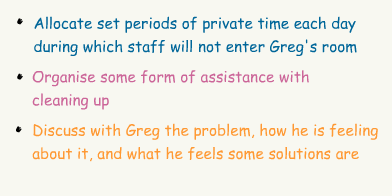
Greg is 22 years old, has a severe brain injury and is in a nursing home. He wants to masturbate but feels that he can’t, as he has little privacy. Staff enter the room without any notice. Also, he isn’t able to clean himself up after masturbating due to restrictions in his upper limb functioning and feels too embarrassed to ask the nursing staff for assistance.
Greg is starting to feel very frustrated with his situation as he feels that no-one is listening to him and no-one can help him.
Staff have discussed whether Greg should be allowed time to masturbate in the privacy of his room and to provide assistance in cleaning up afterwards.

Check your answers here
Peter
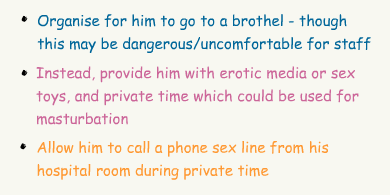
Peter is 24 years old and is in an inpatient rehabilitation service after sustaining a severe TBI. He has made a fairly good cognitive recovery but has significant impairments with his lower limbs, is a one-person transfer, needs assistance to turn in bed and is wheelchair dependent.
Due to the severity of his physical injuries he has been in the rehabilitation unit for a number of months. He is feeling sexually very frustrated. He hadn’t been in a relationship at the time of the injury. He asks one of the rehabilitation staff if they could organise for him to go to a brothel so he can have sex with a sex worker.
Staff have discussed whether they should seek to meet this request, or alternatively, allow him to view some erotic movies and then masturbate in the privacy of his room.

Check your answers here
Jane
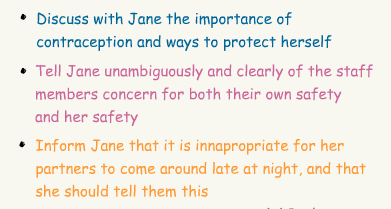
A former street kid, Jane, resumes some of her pre-injury lifestyle while living in a transitional living unit. She starts going to the pub and being freely sexually available to anyone who is interested.
Team members caring for her are concerned that her severe cognitive impairments are reducing her control over what happens in these sexual encounters, whereas once she had been street-wise enough to protect herself.
They are also concerned for the safety of Jane, other clients and staff members, when some of her sexual partners turn up late at night looking for her.
former street kid, Jane, resumed some of her old lifestyle while living in a transitional living unit. She started going to the pub and being freely sexually available to anyone who was interested.
Staff have decided that Jane should be given safer sex counselling and provided with some condoms. Also, they will speak to the publican about her situation, so that there is someone to keep an eye on her.

Check your answers here
What influences your clinical decision-making?
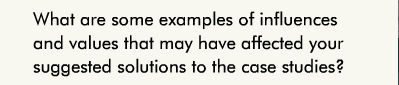
The case studies highlighted a range of values that staff may hold in relation to sexuality and how these might influence or conflict with clinical decision-making in terms of client management. Where would you stand in relation to these cases? What sorts of options would you feel comfortable with in addressing the sexual health issues of Greg, Peter and Jane?
There are many things that influence what courses of action we think are appropriate, especially in issues regarding sexuality. These things include our culture, personal values and those we get from our family and upbringing, our professional training and personal experience.
Check your answers here
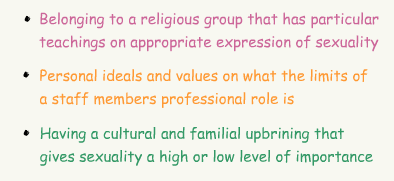
There may be conflict between these different influences which might make it difficult for you to decide what to do. Think about whether such a conflict would affect your actual response.